-
Dear City Council and Mayor:
A couple of years before the storm, my husband went to purchase property in Algiers. When he got out of the car and the real estate agent saw him, she said that she “didn’t sell to n*****s.” There was a lawsuit, a settlement, and other plaintiffs. That woman is still selling property in Algiers today.
On Thursday, I was biking with two other white people. We were coming from Garden Oaks, riding on MacArthur towards the Winn Dixie. A white woman hollered how good it was to “finally see people using the bike lanes.” A black cyclist passed after us, headed towards Garden Oaks. Nothing was said to him.
The majority of the cyclists who use the MacArthur and Holiday bike lanes are black, especially on the stretch from Garden Oaks to Holiday on MacArthur. I know why people like Mr. T. Tucker (see the unread public comments from August 29) have been harassed for using the bike lanes and I have not. Some people don’t want to see black cyclists.
Of course, not everyone opposed to the bike lanes is racist, or even white, but that doesn’t matter in the end. In the end, transportation is a system. And like many systems in the United States, it is a system that is rooted in institutional racism.
Biking is more than a hobby; it is an affordable, accessible, and reliable form of transportation in a city where all of those qualities are lacking in city services. I firmly believe that we can also make this particular service equitable. But when you let a group of people from one of the two whitest and wealthiest neighborhoods in Algiers fight to take away transportation infrastructure that protects vulnerable road users traveling from predominantly black neighborhoods, you are part of a bad and broken system.
You don’t have to be a bad person to be a part of such a system, nor do you need to have bad intentions. But regardless of your rationale, limiting the safety and equity of a system that predominantly benefits historically underserved communities will do more than just harm those communities. In this case, it’s likely to result in legal action. In addition to the racially and economically discriminatory effect of limiting safe and free access to Algiers via public protected bike lanes, a number of people who use the bike lanes are in wheelchairs or have limited mobility. For them, with the unkempt state of city sidewalks, the bike lanes are an immeasurable resource for which there is no equal alternative.
I spoke with a man who is wheelchair bound and lives in one of the assisted living units on MacArthur. He is missing part of his right leg. He is one of the “beggars” several people have shamed online in anti-transit posts, so I know most people in the community don’t put much stock in his opinion. But it occurred to me when I was speaking to him about how he didn’t want the lanes removed that his disability checks, if he even gets them, probably aren’t that much. The bike lanes are his best, safest, and most reliable travel resource. And luckily for him, the Americans with Disabilities Act doesn’t care if you panhandle, so his opinion matters just as much as everyone else’s, even if no one bothered to ask for it.
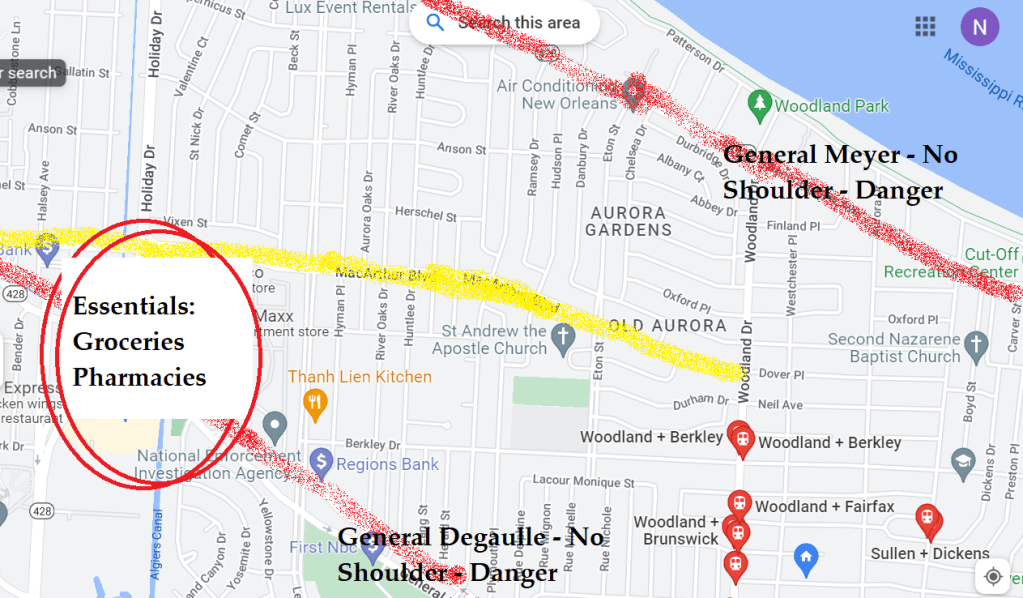
But this seems to be a theme. The people from Jackson Landing, Garden Oaks, Cypress Park, Renaissance Place, and the Cut Off are the people who will truly be most effected by the removal of protected lanes. Sure, the lanes pass in front of the nice houses on MacArthur, but as some homeowners on the MacArthur corridor have yelled time and time again, they don’t use them. But for the people in the periphery communities, the bike lanes are an invaluable access corridor. There is no side street for them to take to get to the grocery stores or pharmacy by bicycle, a fact that is very evident once you look at the map. It was brought up many times in the community meeting that “we were taught not to play in the street.” But biking is no longer just a pastime or exercise; it is a form of transportation. And while a good number of people opposed to protected bike lanes have the privilege of choosing their form of transportation, not everyone has that luxury. That is why the people in these boundary neighborhoods are the real stakeholders. They need the lanes to get to the stores. They need the lanes to get to work. They need the lanes in order to have equal access.
But we already know that the people in these communities have been pushed to the margin. These people who will have safe infrastructure taken away were not even contacted about the community meetings. Nobody went door to door to talk to them. Nobody put signs in their neighborhoods. The best organized engagement effort they received was an Instagram post on a councilman’s account Sunday afternoon before the Wednesday meeting. It is difficult to believe that this effort—or lack thereof—was anything but intentional. It is preposterous to claim “everyone is welcome” when a very specific subset of people failed to even be extended an invitation. With even the shallowest of looks, the platitudes and thinly veiled suggestions of equality fall flat. I biked around handing out my feeble little flyers and with a singular exception in the Cut Off, everyone was in support of keeping the lanes. But with that singular exception, nobody even knew the lanes were likely to be removed.
A recent study from Harvard and Boston University, published in the American Journal of Preventative Medicine found that black cyclists were 4.5 times more likely to die than white cyclists (https://www.ajpmonline.org/article/S0749-3797(22)00155-6/fulltext#seccesectitle0005). Please also see “Transportation, Sustainability, and Equity” published by the Congressional Black Caucus Foundation, written and researched by Richard Ezike, PhD: http://www.cbcfinc.org/wp-content/uploads/2016/10/CBCFTransportationBriefing.pdf. We as a community cannot keep separating into the loud and boisterous haves and the deliberately ignored have-nots. We cannot keep equating convenience and property with real human safety and equality, and we cannot keep having this exact same conversation.
I fully understand that there are a lot of property owners who want the lanes gone and who show up and vote. I fully understand that is a popular and powerful force. I fully understand that I am asking you to stand up for people who may not vote, and may not come to community meetings, and may not be organized. But those are the exact people you took an oath to serve. And in this instance especially, serving them is the right thing to do. Please do the right thing.
Regards,
Naomi Jones
-
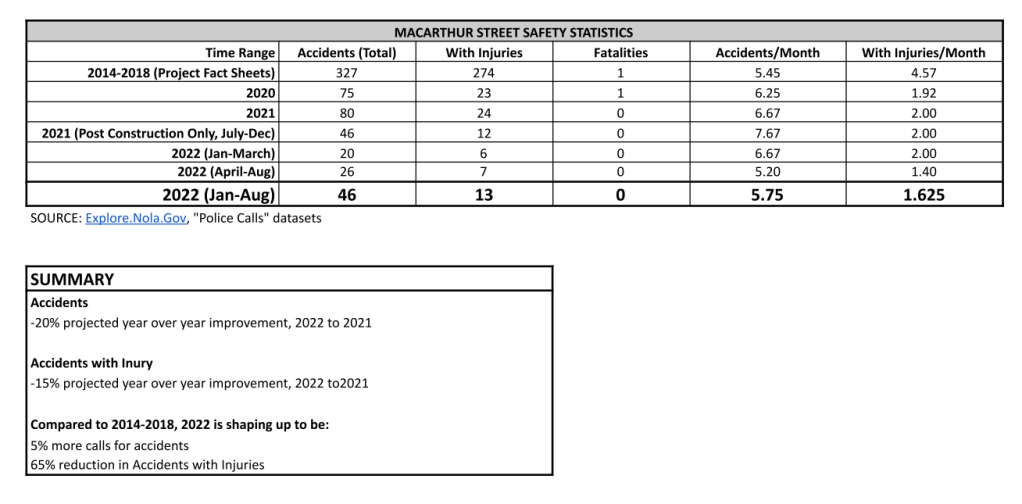

***Credit to Bill Katzenmeyer for taking the time to crunch these numbers. Thank you.
-
City Council votes this Thursday September 15, 2022 on the removal of protected bicycle lanes on MacArthur and Newton. The link to submit an e-comment is not yet posted. Please email City Council your thoughts:
-
Steps you can take to help:
- Come to Alice Harte School on September 7th at 5:30. Fill out a comment card and voice your opinion at the community meeting.
- Set a reminder for September 13th to make an electronic public comment for the September 15th City Council Vote. The link to comment isn’t up yet but you will eventually be able to find it at https://council.nola.gov/meetings/2022/20220915-regular-meeting/
- Email City Council:
- Come to the City Council Meeting on September 15 at 10 AM. Fill out a comment card and speak.
- Share this website or others discussing the issue on social media.
- Follow bestbankbikes and bikeuneasy on Instagram and share.
- Follow bikeeasy and share.
- Email bestbankbikes@gmail.com and we will let you know about any upcoming events related to bike lanes.
- Email bestbankbikes@gmail.com if you want to help flyer, build out the tech, or do anything else that might be helpful. Heaven knows we could obviously use the help.
- Pay attention to future developments in transportation. The same group that is attacking the protected lanes on the Westbank have publicly attacked the need for bike lanes on the East Bank and improvements in bus transportation.
- Talk to people.
- Send us an essay or a picture to publish.
-
September 7, 2022 – 5:30 PM – Alice Harte School – 5300 Berkley Drive –
— This is the community meeting where EVERYONE is welcome to express their opinions on the bike lanes. City council members will be present.
September 15, 2022 – 10:00 AM – City Council Chambers —-
—- This is the City Council Meeting where the Council will vote on Freddie King’s proposed resolution to prohibit protected bike lanes on MacArthur and Newton. — The link to make comments is not up yet, but when it is, it will be here: https://council.nola.gov/meetings/2022/20220915-regular-meeting/
-
Because context is everything, it is important to understand the geography of Algiers, and a little sociology, to understand the need for these bike lanes.
This is the general area of Algiers. It’s narrow and stretches along the river all the way across the Woodland Bridge. Believe it or not, there are cows in Algiers over the Woodland Bridge.
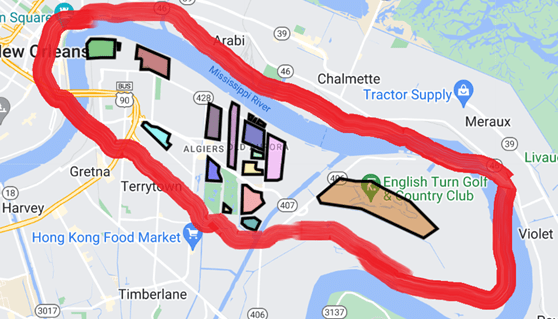
The map below map focuses on the more populated areas of Algiers. You can see what a member of Our Streets called the two main arteries—General Degaulle and MacArthur. Theses streets are the only way to reach pharmacies and groceries for many people coming from neighborhoods around the plaza. Advocates of protected lanes and people opposed to the safe streets design agree on the importance of these streets. Where the disagreement comes in is who should have access to them – because deciding how people can travel is, necessarily, deciding WHO can travel.
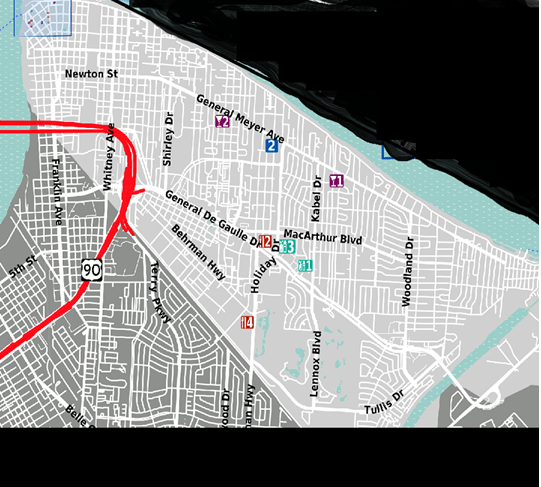
Newton, as depicted above helps link travel for cyclists from one end of Algiers to the other.
Below, is a closer look at the MacArthur corrider. As you can see, there is simply no way to take local streets other than MacArthur or General Degualle to get through Algiers from East to West. The smaller neighborhood streets are interupted by canals and housing developments. “You can’t get there from here.”
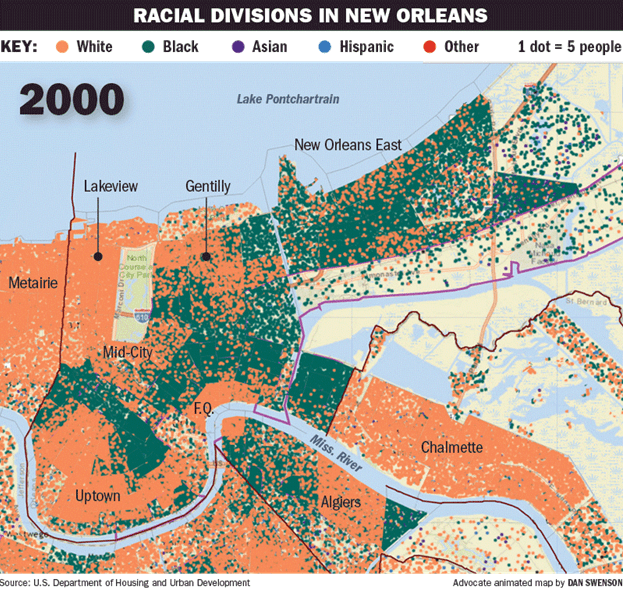
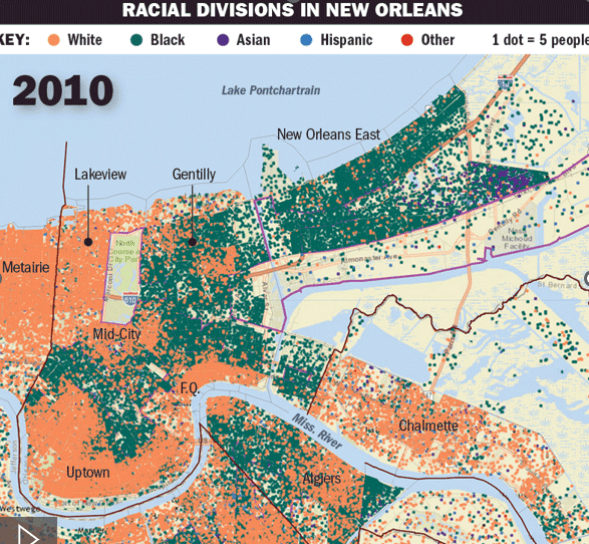
Below is the map that really speaks. It shows the changing make up of Algiers. A quick google search will give you more information about the history of Algiers and a practice known as redlining. The pinkish, orangish, square with “Algiers” on it, that’s where the bike lane cuts through. It links one edge of the wealthy box to the other.
-
Come voice your support for protected bike lanes in Algiers and the entire city.
SEPTEMBER 7, 2022
6:00 PM
Alice Harte School – 5300 Berkley Drive
-Protected Bike Lanes have resulted in a 65% reduction in Accidents with Injury (See https://data.nola.gov/Public-Safety-and-Preparedness/Calls-for-Service-2022/nci8-thrr/data) on MacArthur
-Lanes have Already been redesigned to better accommodate parking and emergency vehicles. DPW worked with the NOFD to ensure that the protected lanes did not obstruct trucks.
-The lanes are the ONLY way to safely travel to pharmacies and grocery stores for residents on bikes.
-The lanes are the ONLY way to safely travel to WORK in Algiers Plaza for residents on bikes.
-
The people submitted 145 comments to City Council. 75% were pro bike lane.
The comments weren’t read.
“What had happened was”…OSOC planned on having a huge in person crowd hating on bike lanes at a city council meeting,
–but almost nobody showed up–
so now they are having a “community meeting.” Which is really a photo op. It’s pretty clear actual people’s actual opinions were pro-bike lane. (See above)
Because OSOC are afraid they won’t get enough anti-bike lane people to show up for the publicity stunt, they are also hosting a mayoral recall event–at the same time. Problematic for sooooo many reasons.
What can you do?
You can show the heck up.
Show up for bike lanes. Show up for integrity. Show up for safety. Show up for the people who are afraid to show up. Show up for the circus, if that’s your thing. But, please show up. Make them hear you.
Alice Harte School. 5300 Berkley. 6:00 PM. September 7.
-
Subscribe
Subscribed
Already have a WordPress.com account? Log in now.
 Save the Bike Lanes